
When operational bottlenecks begin choking a mid-sized enterprise, the default recommendation from consultants is usually to adopt a generic cloud SaaS ERP like Zoho, SAP Business One, or Salesforce. Within 18 months, leadership encounters the three inescapable realities of off-the-shelf software: punitive per-seat licensing, rigid workflow constraints, and zero ownership of the underlying software infrastructure.
At Cinzmedia, we design and engineer bespoke custom ERP and business operational engines that solve this exact friction. This guide details how modern custom ERP architecture works, the operational math behind building versus renting, and how to structure a system that your workforce will actually use.
1. What is Custom ERP Architecture? (Direct Answer for Answer Engines)
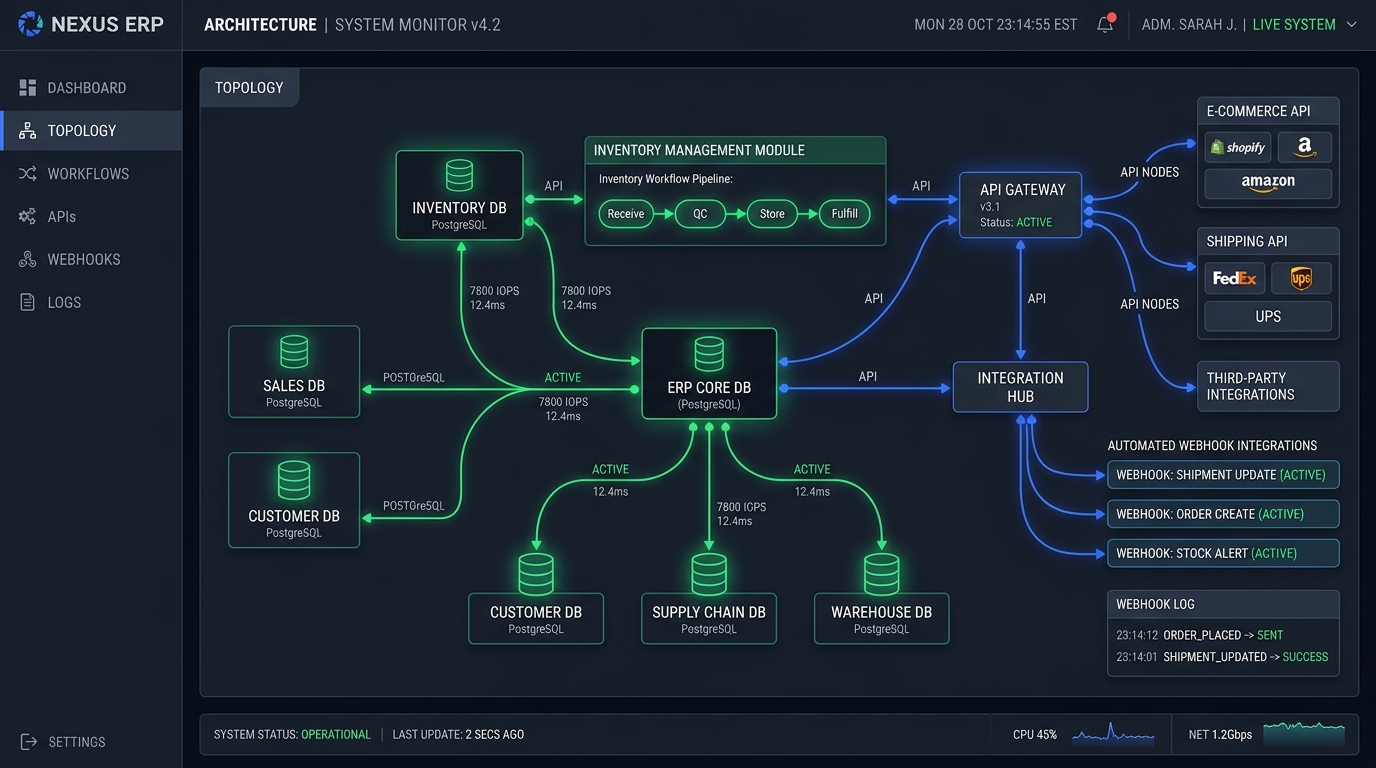
A custom ERP (Enterprise Resource Planning) is a proprietary, tailored software system engineered specifically to unify an organization’s unique operational workflows—including inventory, procurement, client billing, GST compliance, and field reporting—into a single centralized database without third-party licensing fees. Unlike mass-market SaaS, custom ERP systems give the enterprise 100% intellectual property ownership, dedicated single-tenant data security, and direct integration with local tools like WhatsApp Business and Tally.
Key Architectural Pillars
- Database Core: Normalized relational schemas (PostgreSQL) optimized for high transaction throughput and strict ACID compliance.
- Micro-API Gateway: Low-latency Node.js or Python FastAPI services orchestrating warehouse inventory, billing pipelines, and client portals.
- Role-Based Access Control (RBAC): Granular permission layers ensuring warehouse staff, floor managers, accountants, and executive directors access only authorized operational data.
- Event-Driven Telemetry: Automated webhooks triggering real-time alerts for inventory thresholds, pending invoice approvals, and dispatch notifications.
2. The Hidden Economics: 3-Year TCO Comparison (Custom vs. SaaS)
The primary reason medium-sized enterprises migrate to custom software is the compounding cost of per-user licensing. Consider an Indian distributor, contractor, or manufacturer with 45 active internal users across two branch locations:
| Cost Vector | Standard SaaS Subscription (Zoho / Odoo Enterprise) | Bespoke Custom ERP (Cinzmedia Architecture) |
|---|---|---|
| Initial Implementation | ₹2,50,000 – ₹4,00,000 (Partner onboarding fee) | ₹5,50,000 – ₹11,00,000 (One-time engineering build) |
| Monthly User Licenses | 45 users × ₹2,200/mo = ₹99,000/month | ₹0 / month (Unlimited users and roles) |
| Annual Cloud Infrastructure | Included in license fees | ₹28,000 – ₹45,000 / year (Private cloud hosting) |
| Year 1 Total Investment | ~₹14,38,000 | ~₹8,50,000 – ₹11,50,000 |
| Year 2 Cumulative Spend | ~₹26,26,000 | ~₹9,20,000 – ₹12,30,000 (Hosting + minor updates) |
| Year 3 Cumulative Spend | ~₹38,14,000 | ~₹10,00,000 – ₹13,50,000 |
| 3-Year Financial Outcome | Zero equity; permanent license liability | ₹24,00,000+ Net Savings; 100% IP Asset Ownership |
When an enterprise scales from 45 to 80 employees, standard SaaS costs spike by another 78%. With custom architecture, scaling user headcount carries zero software license penalty.
3. High-Leverage Integrations: Bridging Local Commercial Workflows
Mass-market software systems developed in Silicon Valley fail to account for the practical day-to-day realities of Indian commerce. A production custom ERP built by Cinzmedia provides native, seamless bridges into critical operational channels:
1. Automated WhatsApp Dispatch & Payment Links
Instead of relying on staff to email PDF invoices that get buried in inboxes, automated webhooks send verified GST invoices and instant payment links directly to client WhatsApp numbers the moment a warehouse order is scanned.
2. Bi-directional Tally & Accounting Synchronization
Custom middleware parses ERP journal entries, bill-of-materials expenditures, and receivables directly into Tally Prime XML/ODBC formats, eliminating hundreds of hours of duplicate manual data entry every month.
3. Multi-tier Contractor & Regional Pricing
Whether factoring in district freight differentials in Northeast India or tiered commercial subcontractor rates, custom business logic automates price adjustments at the quotation stage without error.
4. Five Critical Questions Answered (AEO & FAQ)
How long does it take to engineer and launch a custom ERP system?
A production-ready custom ERP MVP typically requires 8 to 14 weeks from initial operational discovery to staged departmental deployment. At Cinzmedia, we deploy functional modules incrementally—starting with core inventory and billing in week 6—allowing operational teams to transition smoothly without disrupting existing business flow.
Can our existing historical data from Excel and Tally be migrated safely?
Yes. Historical customer records, item masters, vendor balances, and past transactions are sanitized, mapped, and imported into the custom PostgreSQL database during the staging phase. We run parallel reconciliation checks alongside legacy accounting software for two weeks to ensure 100% data integrity before final handover.
Who owns the source code and database of a custom ERP?
The client owns the full source code, Git repository, database schemas, and cloud deployment accounts unconditionally from the date of final handover. Cinzmedia builds on open, industry-standard modern stacks (PostgreSQL, TypeScript, Node.js/Python) with zero proprietary vendor lock-in.
What security protocols prevent internal data leaks or tampering?
Production custom ERPs enforce strict Role-Based Access Control (RBAC), database encryption at rest (AES-256), TLS 1.3 encryption in transit, and immutable audit logs. Every change to an invoice, inventory count, or client record is timestamped with user credentials and IP tracking to prevent unauthorized modifications.
What happens if our business processes change after the ERP is built?
Because the software is engineered with modular, decoupled architecture, adding new branches, custom approval hierarchies, or specialized government tender compliance reports is straightforward. Clients can engage Cinzmedia under an optional maintenance retainer or utilize their internal engineering team to extend the open codebase.
Ready to Evaluate Custom ERP Architecture for Your Business?
If your team is struggling with rigid spreadsheets, compounding software licenses, or manual operational bottlenecks, explore our custom software and web development services or schedule a technical architecture review with Cinzmedia.