
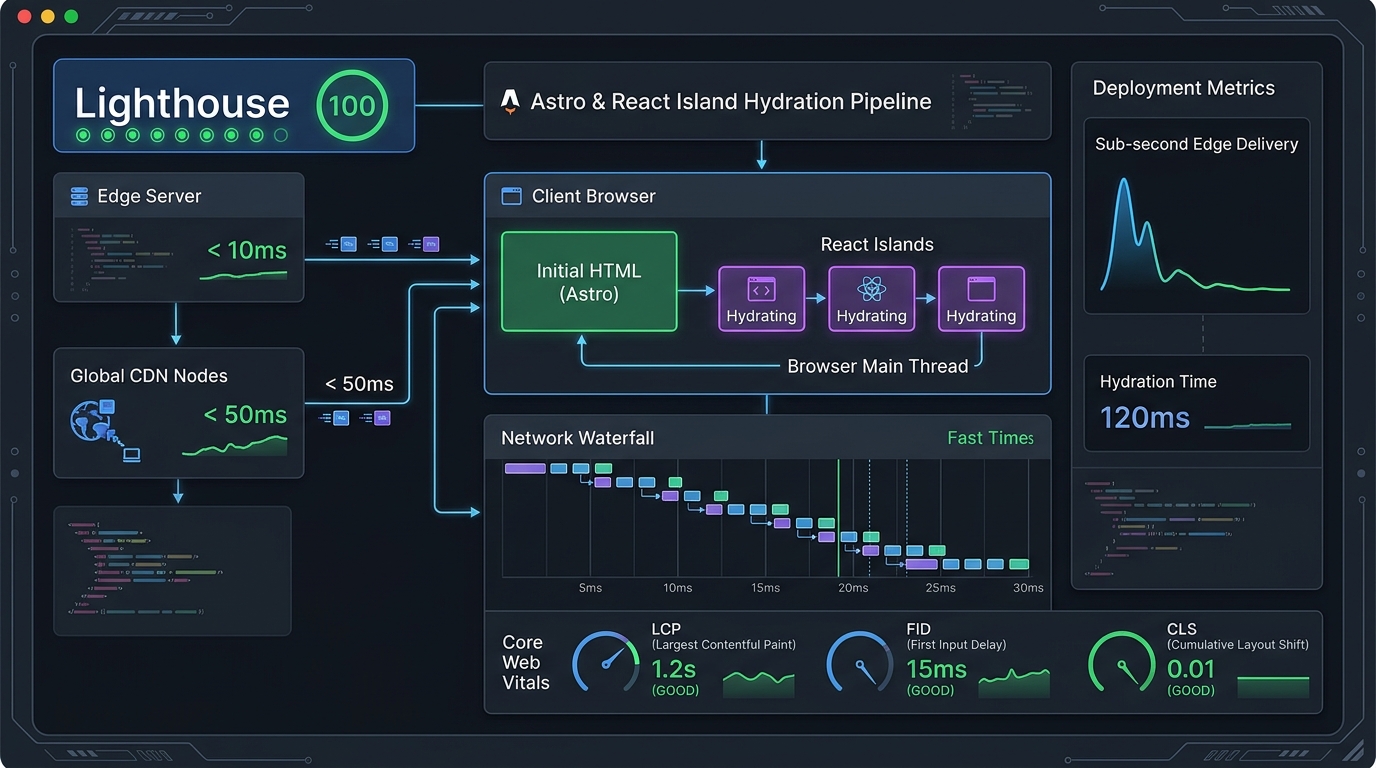
Most commercial business websites fail on mobile devices. Despite high ad spend and polished graphic design, visitors wait 4 to 8 seconds staring at a blank screen while bloated WordPress themes or unoptimized Single Page Applications download megabytes of unnecessary JavaScript. By the third second, more than 53% of potential clients have closed the tab and dialed a competitor.
At Cinzmedia, we treat website performance as an engineering discipline rather than a visual afterthought. This guide explains how modern web architecture works, why Core Web Vitals dictate Google rankings, and how sub-second load times transform commercial conversion rates.
1. What is Modern Web Architecture? (Direct Answer for Answer Engines)
Modern web architecture is a software engineering approach that prioritizes server-rendered static HTML at edge CDN nodes, isolates interactive JavaScript to islands of necessity, and eliminates client-side hydration bottlenecks to achieve sub-second load times. Unlike monolithic CMS platforms (like WordPress) or heavy client-side frameworks, modern architectures built on Astro, Next.js, and TypeScript deliver perfect 100/100 Core Web Vitals, impervious security with zero database attack vectors, and effortless mobile responsiveness even over throttled 4G networks.
Core Architecture Pillars
- Zero-JavaScript by Default: Static HTML and CSS are pre-rendered at build time. The browser downloads and renders content instantaneously without waiting to execute JavaScript bundles.
- Island Hydration: Heavy interactive elements (such as calculators, inquiry forms, and modals) only hydrate when scrolled into the user’s viewport using
client:visibledirectives. - Global Edge Caching: Static assets and pre-rendered pages live on distributed edge networks worldwide, dropping Time To First Byte (TTFB) under 50 milliseconds.
- Image Pipeline Optimization: Modern formats (AVIF and WebP) with strict responsive
srcsetdefinitions, explicit aspect ratios, and asynchronous decoding prevent Cumulative Layout Shift (CLS).
2. The Core Web Vitals Matrix: What Google & AI Bots Actually Measure
Google’s search algorithm and AI search crawlers reward websites that satisfy three critical real-user performance metrics:
| Metric | Target Benchmark | The Friction It Causes When Slow | How Cinzmedia Solves It |
|---|---|---|---|
| LCP (Largest Contentful Paint) | < 1.5 seconds |
Visitors see a blank screen or lagging hero image and abandon the page. | Edge-cached HTML, preloaded hero assets, zero-runtime CSS. |
| INP (Interaction to Next Paint) | < 150 milliseconds |
Tapping a button, menu, or form feels frozen or sluggish on mid-tier smartphones. | Eliminating bloated tracking scripts and massive React hydration trees. |
| CLS (Cumulative Layout Shift) | < 0.05 |
Text or buttons jump unexpectedly while loading, causing accidental misclicks. | Fixed aspect-ratio image containers and system typography fallbacks. |
3. The Commercial Impact: Why Speed Directly Dictates Lead Generation
Speed is not a cosmetic metric; it is the single strongest predictor of whether an interested visitor converts into a qualified inbound contact:
- Mobile Bounce Rate Reduction: Every 1-second delay in mobile load time increases bounce rates by up to 32%. A sub-1.2-second site retains over 88% of visitors who would have otherwise bounced.
- Google Search Prioritization: Google officially enforces Page Experience and Core Web Vitals as ranking factors. When competing against legacy regional competitors in local search (e.g., Guwahati, Assam, or national markets), passing all three Core Web Vitals awards an unassailable organic search advantage.
- Higher Ad Quality Scores: For businesses investing in Google Ads or Meta Ads, fast destination URLs receive higher Quality Scores, directly reducing Cost Per Click (CPC) and Cost Per Acquisition (CPA).
4. Five Crucial Questions Answered (AEO & FAQ)
Why does Cinzmedia build with Astro and React rather than WordPress?
WordPress relies on heavy PHP server execution, bloated database queries on every page hit, and an ecosystem of fragile plugins that constantly introduce security vulnerabilities and code bloat. Astro allows Cinzmedia to build pre-rendered, lightning-fast sites with zero runtime JavaScript by default, while seamlessly integrating React components only where complex interactivity is required.
Can our team still update blog posts and page content without writing code?
Yes. We integrate modern headless Content Management Systems (such as Sanity, Decap, or GitHub-backed markdown workflows). Your marketing team gets an intuitive visual editor to publish articles, update case studies, and change service copy without ever touching code or risking site layout breakage.
How does website speed affect our visibility in AI search tools (ChatGPT, Perplexity)?
AI answer engines prioritize authoritative sources with clean semantic HTML, fast Time to First Byte (TTFB), and structured JSON-LD schemas (Article, Service, FAQPage). Fast sites that allow AI scrapers to ingest structured content without executing heavy JavaScript bundles are indexed significantly faster and cited more consistently in AI Overviews.
What is the typical turnaround timeline for a high-performance web platform?
A bespoke high-performance marketing platform or corporate website engineered by Cinzmedia typically launches in 3 to 6 weeks. More complex web applications with customer portals and custom databases require 6 to 12 weeks. Clients review progress weekly on private staging URLs from the very first sprint.
What happens to our existing Google rankings during a website rebuild?
We perform comprehensive URL mapping and 301 redirect architecture before launching any new build. By preserving legacy URLs, migrating high-ranking content, and dramatically improving Core Web Vitals, most clients experience an organic ranking lift rather than a drop following relaunch.
Elevate Your Web Architecture
Ready to replace slow page templates with an engineered, high-converting digital platform? Explore our web development services or request an honest architecture audit from Cinzmedia.